


Navigating the financial intricacies of a church or ministry can be a complex undertaking, especially when it comes to managing payroll. Unlike for-profit businesses, churches operate with unique tax structures, compensation models, and a mission-driven focus that demands specialized solutions.
In 2026, the landscape of payroll software offers powerful tools to streamline these processes, ensure compliance, and free up valuable resources. However, with a myriad of options available – and real consequences for getting it wrong – finding the right solution for your ministry matters more than ever. This guide is designed to illuminate the path to selecting the ideal payroll approach for your church, ensuring accuracy, compliance, and peace of mind as you continue your vital work.
The Distinct Challenges of Church Payroll Management
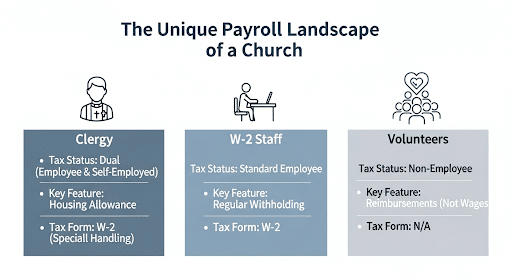
Church payroll is not simply a scaled-down version of corporate payroll. It operates under a distinct set of rules that most general business solutions were never designed to handle.
The primary challenge is the unique tax treatment of clergy. Ministers are considered employees of the church for income tax purposes but are treated as self-employed for Social Security and Medicare tax purposes by the IRS. This dual status requires careful handling of compensation – particularly the Clergy Housing Allowance, which can be a significant tax-advantaged benefit when documented correctly, and a costly liability when it isn’t.
Beyond clergy, ministries employ administrative staff, janitorial teams, and program directors, each requiring standard W-2 handling. Distinguishing between paid staff and volunteers is equally critical, as improperly handled stipends or reimbursements can trigger unexpected tax liabilities. Add fund accounting requirements – where expenses must be allocated to specific ministry programs – and you have a payroll environment that genuinely requires specialized expertise.
It’s worth noting: nearly 50% of churches that have their payroll reviewed by church-specific professionals for the first time are found to have errors. Almost always, those errors stem from processing church payroll according to standard corporate rules rather than church-specific law.
Why Finding the Right Payroll Approach Is Crucial for Your Ministry
The right payroll solution is more than just a tool for cutting checks – it’s a cornerstone of responsible financial stewardship. Accurate, on-time compensation directly affects staff retention. With 49% of workers saying they’ll look for a new job after just two payroll mistakes, accuracy is non-negotiable.
Beyond employee satisfaction, payroll errors carry real regulatory risk. Automated tax calculations, accurate withholdings, and timely filings free up invaluable administrative time – allowing staff to focus on ministry rather than back-office complexity. Proper payroll management is foundational to maintaining trust and operational integrity, both internally and with the IRS.
Understanding Church Payroll: Unique Tax Laws and Operational Nuances
Clergy Compensation: Housing Allowances and Self-Employment Tax
Ministers hold a unique “dual tax status” under IRS rules. They receive a W-2 as employees for income tax purposes, but pay self-employment taxes (SECA) at the full 15.3% rate on their own – the church does not withhold or match FICA for ordained or licensed ministers. The Clergy Housing Allowance, a portion of compensation designated for housing expenses, can be excluded from taxable income when properly documented in advance. Correct designation is critical; retroactive housing allowance designations are not permitted by the IRS.
Non-Clergy Employees: Standard Payroll Rules Apply
Lay employees – administrative assistants, worship directors, custodial staff – are treated as standard W-2 employees. The church withholds income taxes and the employee share of FICA (7.65%) and pays the employer’s matching share. Accurate tracking of wages, hours, and tax liabilities is essential for compliance and for avoiding penalties associated with incorrect filings.
Volunteers vs. Paid Staff
Ministries rely heavily on volunteers, and misclassifying a volunteer relationship – or improperly documenting reimbursements – can create unexpected tax liabilities. Any stipends paid to volunteers may be considered taxable income, requiring appropriate reporting. Clear documentation is the foundation of compliance here.
Federal, State, and Local Compliance
Churches must file Form 941 quarterly, and comply with state new hire reporting requirements. Failure to meet these obligations can result in substantial fines and penalties, diverting vital funds from ministry initiatives.
Fund Accounting Integration
Payroll expenses must be accurately allocated to the appropriate funds – general fund, missions fund, building fund, and others. Payroll solutions that can integrate with fund accounting systems or provide departmental breakdowns are invaluable for maintaining financial transparency and supporting accurate board reporting.
Essential Features Your Church Payroll Software Must Have
- Core payroll processing – automated paychecks, direct deposit, and ACH payment processing
- Clergy-specific tax support – accurate housing allowance calculation, documentation, and SECA handling
- Comprehensive tax management – federal, state, and local withholdings; automated W-2 and 1099 generation; Form 940 filings
- Robust reporting – fund-level and departmental breakdowns that support budgeting and governance
- User-friendliness – intuitive enough for administrators without deep payroll backgrounds
- Reliable support – knowledgeable representatives who understand church-specific requirements, not generic corporate payroll
- Security – industry-standard encryption and data protection for sensitive employee and financial information
Top 3 Payroll Software Options for Churches in 2026
The right software for your church depends on size, existing systems, and how much in-house expertise you have available. Here’s how the leading platforms compare:
QuickBooks Online Payroll – Best for Churches Already Using QuickBooks
For churches standardized on QuickBooks Online for accounting, the payroll module offers seamless integration that eliminates duplicate data entry. It handles W-2 and 1099 processing and syncs directly with QuickBooks’ financial reporting. Its strength is the unified ecosystem – not specialized church payroll expertise. Churches using it should ensure their administrator understands clergy-specific configuration requirements, which QuickBooks does not automate by default.
Gusto – Best for Modern Churches Seeking HR Automation
Gusto offers a polished, user-friendly platform extending beyond payroll into onboarding, time tracking, and benefits administration (health insurance, 401(k)). Its automated compliance tools help with standard tax obligations. It’s an accessible option for churches with straightforward payroll needs, though clergy-specific configurations require deliberate setup that the platform doesn’t guide users through automatically.
SurePayroll – Best for Small to Medium-Sized Churches
SurePayroll offers simplified, full-service payroll with automated tax calculations, direct deposit, and employee self-service. It’s a strong option for smaller churches that need core payroll handled reliably without extensive HR features. US-based support is available, though as with most SaaS platforms, church-specific configuration depends heavily on how well the initial setup is done.
A Note on Software Limitations for Church Payroll
Most large SaaS payroll platforms can technically process church payroll. But technical capability and accurate church payroll are not the same thing. Without proper configuration and ongoing maintenance, these platforms frequently miss the details that make ministerial compensation unique – housing allowance documentation, FICA exclusions for ministers, worker classification, state-specific ministerial requirements. The setup burden falls on the church administrator, and the consequences of misconfiguration can take years to surface and correct.
Beyond the Paycheck: Advanced Features That Add Operational Value
Modern payroll platforms offer functionality that extends well beyond compensation processing:
- Employee self-service portals – staff access to pay stubs, W-2s, and PTO management without administrative bottlenecks
- Integrated time tracking – electronic timekeeping that feeds directly into payroll calculations
- Benefits administration – streamlined enrollment and contribution management for health plans and retirement accounts
Choosing Your Approach: Practical Guidance for Churches
When evaluating options, consider:
- The ratio of clergy to non-clergy on your staff and the complexity of housing allowance structures
- Whether you have in-house administrative capacity to properly configure and maintain a SaaS platform
- The total cost of ownership – setup fees, add-ons, ongoing support, and the hidden cost of errors that require correction
- Integration requirements with your existing accounting and church management systems
- Whether your provider or platform has demonstrable experience with church-specific tax law – not just general nonprofit payroll
Is Church Payroll Feeling More Complex Than Your Team Can Handle?
If processing church payroll accurately – managing housing allowances, classifying ministerial versus lay staff, handling FICA exclusions, and keeping up with quarterly IRS filings – feels like more than your administrative team should be navigating alone, you’re not the only one.
ChurchShield is a faith-based firm with over 100 years of combined team experience in church accounting, payroll, HR, and compliance – built specifically to serve ministries of all sizes. Unlike generic SaaS platforms, ChurchShield’s payroll professionals are trained in the nuances of church-specific tax law and handle everything from housing allowance designation and worker classification to quarterly Form 941 filings and W-2 preparation. We manage the complexity from end to end, so your staff and leadership can stay focused on ministry.
Whether you need standard or full-service payroll, ChurchShield offers both – and many payroll clients also engage us for HR and accounting, since these services are tightly integrated in our firm’s workflow.
Free to minister. That’s the goal. Let ChurchShield get you there.
Explore ChurchShield’s Church Payroll Services →
Putting it All Together
Effectively managing church payroll is a critical component of responsible financial stewardship, directly impacting staff satisfaction, ministry efficiency, and compliance standing. The right approach – whether software, outsourced service, or a combination – depends on your church’s size, internal capacity, and risk tolerance for configuration errors.
The tools covered in this guide each offer genuine strengths. But the most important factor in church payroll accuracy isn’t which platform you use – it’s whether the people managing it understand how church payroll actually works. For ministries that want that assurance built in from day one, ChurchShield exists precisely for that purpose.
Recent Comments