

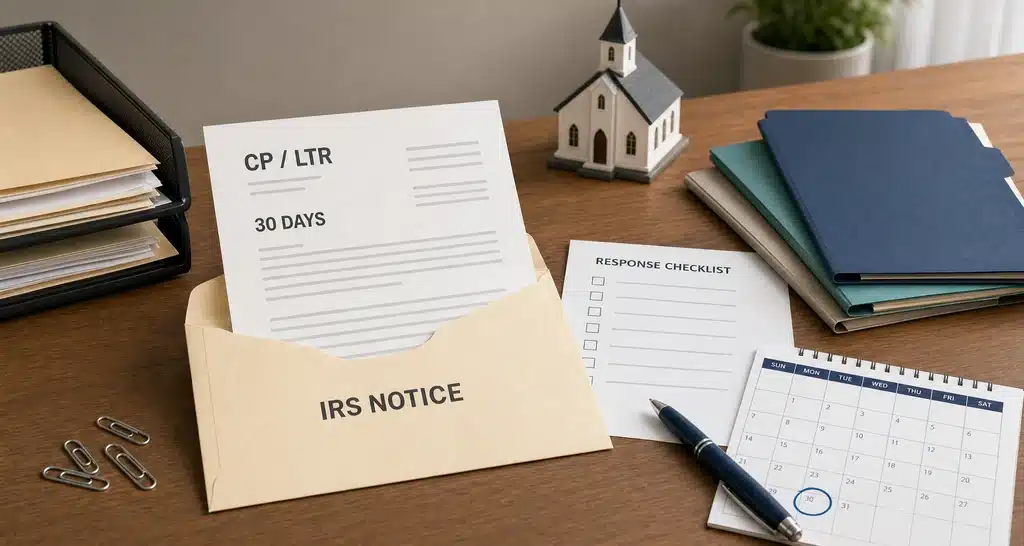
Few pieces of mail unsettle a church office like an envelope from the IRS. An official notice can feel like an accusation — but it is not a verdict. In most cases it is a routine request: a missing form, a mismatched deposit, or a question needing a documented answer. What matters is not the letter itself, but how — and how quickly — your church responds.
Why IRS Notices Are Different for Churches
Churches operate under IRS rules, exemptions, and legal considerations unlike any other organization, and that uniqueness cuts both ways. They enjoy benefits no business or regular nonprofit receives, but they also carry compliance responsibilities that are hard to handle without specialized expertise. When a notice arrives, a church must first work out which rules apply and if they were applied correctly. Under deadline pressure, it is easy to overreact or ignore the notice — and neither serves the ministry well.
What Your Church Needs to Know
Don’t Panic — But Don’t Ignore It
Most IRS notices are routine — many simply ask for clarification or flag a discrepancy a letter and documentation can correct. Panic leads to rushed, incomplete responses; avoidance leads to escalating penalties and interest. The right posture is calm, prompt attention. Note, too, that the IRS makes contact by mail; treat an aggressive call, email, or text demanding payment as a likely scam.
Identify Exactly What You Received
Every legitimate IRS notice carries a notice or letter number — often beginning with “CP” or “LTR” — plus the tax period, the reason for contact, and a deadline. Identifying the type tells you what is actually being asked. Common notices churches receive include:
- Payroll and employment tax notices — discrepancies, balances due, or deposit issues tied to a Form 941 filing.
- Information return notices, such as a CP2100 — a name or TIN on a filed 1099 doesn’t match IRS records, possibly triggering backup withholding.
- Penalty or interest notices — for late filings, deposits, or payments.
- Status or activity inquiries — about tax-exempt status or unrelated business income.
Payroll Notices Deserve Extra Attention
A large share of church notices trace back to payroll, and that is no coincidence. Church payroll is unlike any other employer’s: ministers have dual tax status, housing allowances must be designated in advance and in writing, and ordained or licensed ministers are excluded from FICA withholding. ChurchShield has found that nearly 75% of churches that have their payroll reviewed for the first time have errors — almost always because payroll was processed under standard corporate rules rather than church-specific law. A payroll notice is often a setup problem that will recur until the root cause is fixed.
Know Your Special Protections — and Their Limits
Few church leaders realize that churches have procedural protections other taxpayers don’t. Under Section 7611 of the tax code, the IRS cannot simply open an examination of a church’s tax-exempt status or unrelated business income; an inquiry can begin only if a high-level Treasury official reasonably believes, based on written facts, that there may be a problem, and the church must receive written notice of the concern. But these protections are narrow — they cover exempt status and unrelated business income, not routine payroll matters or information-return matching. A CP2100 or payroll notice is not a “church audit,” and Section 7611 does not excuse your church from responding promptly. Most notices also carry a deadline, often around 30 days; responding on time stops penalties from compounding and preserves your appeal rights.
A Step-by-Step Response Checklist
When a notice arrives:
- Open it immediately and read it in full — note the notice number, tax period, and deadline.
- Verify it is genuine; legitimate notices arrive by mail.
- Don’t pay or sign anything reflexively — a notice can be wrong.
- Gather documentation: returns, payroll records, board minutes, and prior correspondence for the period.
- Determine the category — and whether Section 7611 protections apply.
- Respond in writing, completely and on time, and keep a copy.
- Fix the root cause so the notice doesn’t return next quarter.
- Get specialized help when exempt status, unrelated business income, or any unclear question is involved.
Let ChurchShield Handle the Response
If responding to an IRS notice — and knowing which protections actually apply to your church — feels like more than your administrative team should navigate alone, you are not the only one.
ChurchShield is a faith-based firm with over 100 years of combined team experience in church accounting, payroll, tax, and IRS compliance, built specifically for ministries of all sizes. Our compliance team interprets IRS notices, responds accurately and on time, fixes the underlying issue, and represents the ministry directly in urgent IRS matters.
Free to minister. That’s the goal. Let ChurchShield get you there.
Learn more about our Church Tax & IRS Compliance Services or contact our team directly.
An IRS Notice Is Manageable
An IRS notice is not a crisis unless it is ignored. The challenge is rarely the letter itself — it is knowing which rules apply, which protections are in play, and how to respond accurately before the deadline. Handled calmly and with church-specific expertise, most notices are resolved without lasting consequence — freeing the ministry to put the envelope down and get back to its calling: free to minister.
Recent Comments