

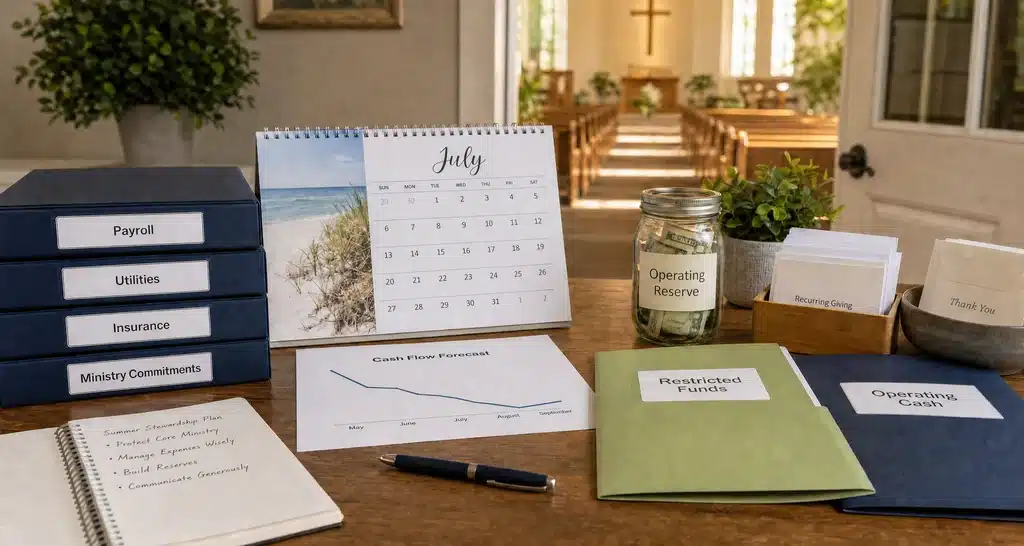
Every church treasurer knows the feeling. The first warm Sunday arrives, the sanctuary looks a little emptier, and a few weeks later the bank balance confirms what attendance already suggested. Summer has a way of quietly tightening a church’s finances — and for ministries already operating on a narrow margin, that tightening can become a genuine cash flow problem by July.
The summer giving slump is predictable. The challenge is that knowing it’s coming and being prepared for it are two very different things.
The Problem: Income Dips, Expenses Don’t
Giving in most churches is closely tied to attendance, and attendance falls sharply in the summer. The Unstuck Group has reported that worship attendance can drop by roughly a quarter in June and a third in July, with giving following close behind — often not fully recovering until late fall. (Churches should verify these patterns against their own historical giving data.)
Expenses, meanwhile, hold steady. Staff salaries, mortgage or lease payments, utilities, insurance, and ministry commitments don’t pause for the summer season. In fact, many churches spend more in the summer — funding camps, mission trips, and vacation Bible school — during a time when income is at its lowest. The gap between steady outflow and seasonal inflow is where cash flow trouble can live.
For churches, this isn’t just a budgeting inconvenience. Every dollar in the account was given by a member as an act of stewardship. A cash crunch that forces a delayed payment or a borrowed-from fund isn’t only a financial misstep — it pulls focus and resources away from the mission.
What Churches Need to Know
A budget is not a cash flow forecast
Most churches build an annual budget that balances on paper across twelve months. But a balanced annual budget can still produce a cash shortage in July, because income and expenses don’t arrive evenly. The tool that actually prevents a summer crunch is a month-by-month cash flow forecast — a projection of what will come in and go out each month, so a shortfall is visible in February rather than discovered in July.
Know which funds you can actually use
This is where church finances differ from a business. A church may show a healthy total bank balance while having very little it can responsibly spend. Restricted and designated funds — building funds, mission gifts, memorial donations — were all given for a specific purpose, and donor intent is tobe honored. Borrowing from a restricted fund to cover summer payroll is both a stewardship failure and a compliance risk. Proper fund accounting keeps unrestricted operating dollars clearly separated from money that only looks available.
Protect your fixed costs first
Payroll is a church’s single largest fixed expense, and the one with the least flexibility — staff still need to be paid on time and accurately, regardless of the season. It’s worth noting that ChurchShield has found nearly 50% of churches that have their payroll reviewed for the first time contain errors, usually because processing followed standard corporate rules rather than church-specific law. A summer cash crunch is the worst possible time to discover a payroll problem. Knowing your true fixed monthly obligation, and protecting it — is the foundation of summer planning.
Build an operating reserve
The long-term answer to a seasonal dip is an operating reserve: ideally enough unrestricted cash to cover two to three months of operating expenses. A reserve turns the summer slump from a crisis into a planned, funded part of the year.
Practical Guidance
Heading into the summer, churches should:
- Build a rolling 12-month cash flow forecast and update it monthly
- Identify the leanest projected month before it arrives
- Confirm which funds are truly unrestricted before counting on them
- Communicate early with the congregation about consistent and recurring giving
- Trim or re-time discretionary spending around the known low point
- Begin building, or replenishing, an operating reserve
A note on tools: online and recurring giving platforms genuinely help smooth seasonal income, and accounting software can show you where you stand today. But software reports the past — it doesn’t forecast the months ahead or tell you which funds you can responsibly use. That interpretation still takes church-specific expertise.
Free to Minister
If forecasting cash flow, separating restricted funds, and protecting payroll through the summer feels like more than your administrative team should be navigating alone, you’re not the only one.
ChurchShield is a faith-based firm with over 100 years of combined team experience in church accounting — built specifically to serve ministries of all sizes. Our team handles outsourced bookkeeping, fund accounting, and cash management reporting end to end, so your leadership can see a summer shortfall coming and plan for it with confidence.
Free to minister. That’s the goal. Let ChurchShield get you there.
Learn more about ChurchShield’s church accounting services.
Plan for the Summer Slump Before It Arrives
The summer giving slump isn’t a surprise – it’s a pattern. Churches that struggle through it are usually the ones that treat a balanced annual budget as a cash flow plan. Churches that move through it smoothly are the ones that forecasted the dip, knew exactly which dollars they could use, protected their fixed costs, and built a reserve for the season. Plan for the slump before it arrives, and summer becomes just another month on the calendar – not a threat to the ministry.
Recent Comments