

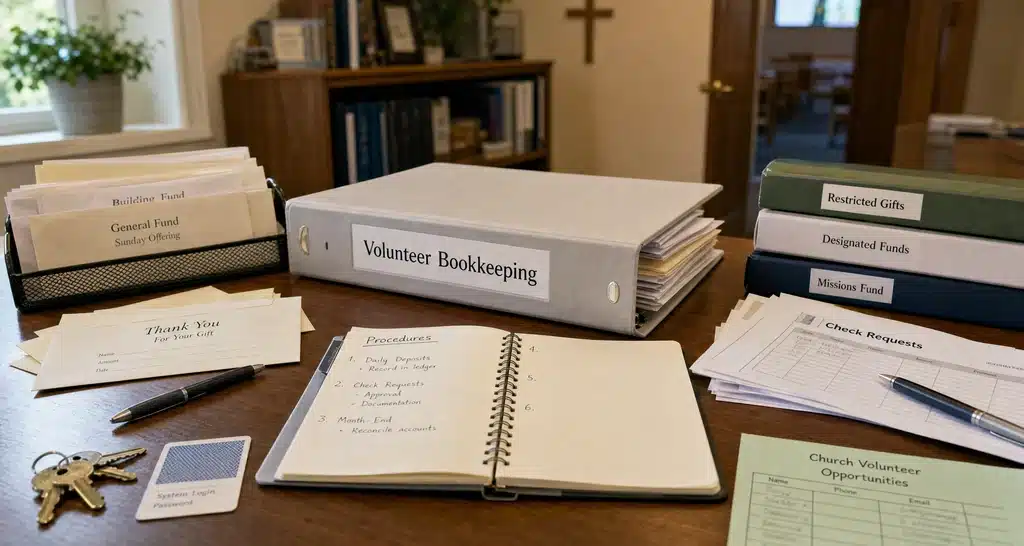
Few things reflect a church’s spirit of service like a volunteer who steps forward to keep the books. It’s an act of stewardship. But a willing heart and the specialized knowledge church finances demand are two different things. The costs of an under-supported volunteer bookkeeper are real; they’re just hidden, surfacing months or years later as compliance problems, strained relationships, or money that quietly went missing.
Why Church Bookkeeping Is Harder Than It Looks
Church accounting isn’t standard business accounting. Churches operate under nonprofit standards built around accountability and stewardship: tracking restricted and designated gifts so every dollar serves its intended purpose, maintaining proper fund accounting, and producing accurate contribution statements for donors. There’s also a real difference between bookkeeping, which records revenues and expenses, and accounting, which also maintains assets, liabilities, and funds for outside readers. Many volunteer arrangements deliver the former while the church assumes it’s getting the latter.
Cost #1: Knowledge Gaps That Compound Over Time
The most common hidden cost is the slow accumulation of small errors. A volunteer may not know that a designated gift can’t be redirected to the general fund, or that church payroll follows rules most businesses never encounter: ministers are employees for income tax but self-employed for Social Security and Medicare, and a housing allowance must be designated in advance and in writing. ChurchShield has found that nearly 50% of churches that have their payroll reviewed for the first time have errors, almost always because the work was done under standard corporate rules rather than church-specific law. That’s why ChurchShield’s staff are degreed accountants, not bookkeepers.
Cost #2: When the Volunteer Leaves, the Knowledge Leaves Too
Volunteer roles turn over. When that happens, churches often discover the entire financial process lived in one person’s head: passwords, procedures, the logic behind fund categorization, none of it documented. The church then has to reconstruct that knowledge and train a replacement from an incomplete trail. Outsourced accounting keeps the expertise, documentation, and continuity in place no matter who comes and goes.
Cost #3: Weak Internal Controls and Fraud Exposure
When one trusted volunteer records the giving, writes the checks, and reconciles the bank statement, there’s no separation of duties, the single most important safeguard against fraud. According to the Association of Certified Fraud Examiners’ 2024 Report to the Nations, more than half of occupational frauds trace back to missing or overridden internal controls, and smaller organizations saw a median loss of roughly $141,000 per case. Fraud in a church is rarely an outsider; it’s usually someone trusted with unchecked access. Strong controls aren’t an accusation against a faithful volunteer, they protect that volunteer and the church alike.
Cost #4: Audit and Compliance Readiness Gaps
Eventually most churches need financial statements an outside party can rely on, such as a bank evaluating a building loan or a grantmaker checking eligibility, alongside ongoing obligations like maintaining tax-exempt status and correct worker classification. When the books have been kept informally, audit readiness becomes a scramble of cleanup, restated balances, and consultant fees that dwarf consistent professional accounting. The hidden cost isn’t just money; it’s delay at exactly the wrong moment.
Cost #5: The Relational and Ministry Toll
There’s a human cost financial statements never capture. Placing a volunteer in a role that doesn’t match their skills produces stress and waning confidence, and when an error eventually surfaces, the fallout can strain a relationship with a faithful member who only wanted to help. Every hour spent wrestling with the books is an hour not spent on ministry. The goal is for a church’s people to lead ministry instead of leading QuickBooks.
A Note on Software
Volunteer bookkeepers often lean on software like QuickBooks or Aplos, and these tools can be genuinely useful. But software is only as church-aware as the person configuring it. These platforms can technically handle fund tracking and clergy payroll, yet they won’t flag a misclassified minister or set themselves up correctly. Without expert configuration and ongoing maintenance, the setup burden and the error risk still fall on the church.
What Churches Can Do
Reducing these costs is practical, even for churches with limited staff:
- Separate financial duties. No single person should record giving, sign checks, and reconcile the bank account.
- Document the process, not just the numbers, so the knowledge survives a transition.
- Know whether you need bookkeeping or accounting. If an outside party will ever read your statements, basic bookkeeping isn’t enough.
- Build in a periodic outside review to catch errors early, before they compound.
- Match volunteers to roles that fit. Stewardship of donated funds shouldn’t rest on one untrained person, however willing.
- Consider outsourcing the function entirely. For many ministries it costs less than the true price of the in-house alternative.
If keeping church finances accurate, compliant, and audit-ready feels like more than your volunteers should be navigating alone, you’re not the only one.
ChurchShield is a faith-based firm with over 100 years of combined team experience in church accounting, built specifically to serve ministries of all sizes. Our team handles the full picture end to end: fund accounting, restricted and designated gift tracking, reconciliation, donor contribution statements, and audit-ready financial reporting.
Free to Minister. That’s the goal. Let ChurchShield get you there.
Learn more about ChurchShield’s church accounting services
The Bottom Line
The volunteer who keeps your church’s books is almost never the problem. The problem is asking one person to carry a specialized discipline without the training, controls, continuity, and backup the work requires. Churches are stewards of funds given sacrificially toward a mission, and protecting those funds with sound, church-specific accounting isn’t a distraction from ministry. It’s part of doing ministry well, and it frees a congregation’s people to do what they were called to do.
Sources
Fraud statistics: Association of Certified Fraud Examiners, Occupational Fraud 2024: A Report to the Nations. Payroll error rate and firm experience figures: churchshield.com. Statistics should be confirmed against the latest published sources before publication.
Recent Comments