

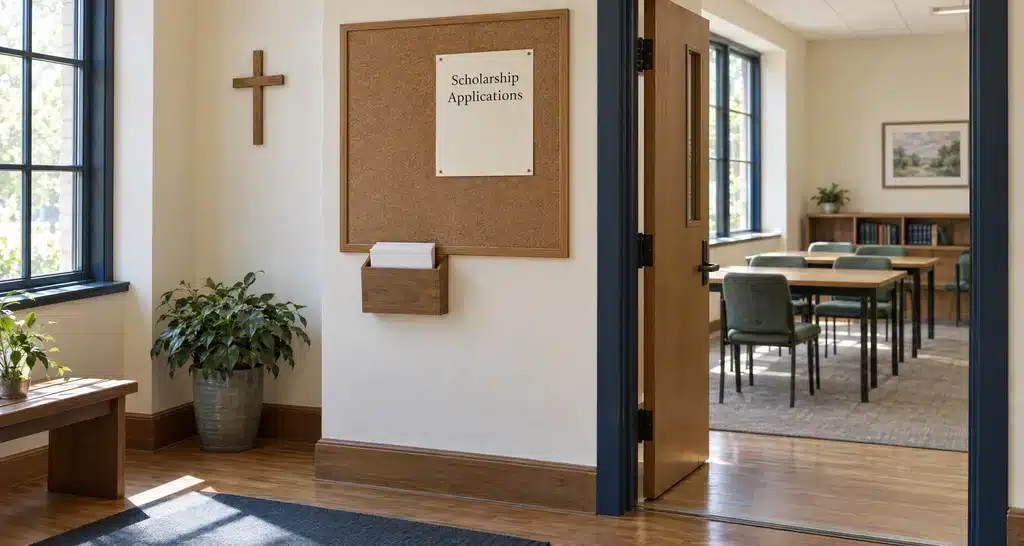
A church scholarship fund is one of the most tangible ways a congregation can invest in its young people. Whether it begins with a Graduation Sunday tradition, a memorial gift honoring a longtime member, or a board that simply wants to help students afford school, the impulse is good stewardship. The rules that surround it, though, are easy to miss.
Every scholarship fund has to answer two tax questions before the first award is made. First, are the gifts your members put into the fund deductible for them? Second, is the money a student receives taxable income to that student? The answers depend on how you set the fund up, and getting the structure right at the start is far easier than repairing it later.
Why churches start scholarship funds, and the two tax questions to answer first
Churches launch scholarship funds for all kinds of reasons: to celebrate graduates, to support students entering ministry, to honor a beloved teacher, or to relieve college costs for families in the congregation. Because a church is already a tax-exempt organization described in section 501(c)(3) of the Internal Revenue Code, it does not need to create a new entity or seek separate IRS approval to give scholarships. The fund can live inside the church’s existing structure as a designated fund on the books. That is true whether you plan to award one scholarship each spring or build an endowed fund that supports students for decades.
That head start comes with responsibility. The same rules that protect your church’s exempt status, found in our overview of the IRS rules for churches, govern how scholarship money is raised, who may receive it, and how the selection is documented. A fund that operates informally can put both donor deductions and the church’s standing at risk.
The donor side: keeping gifts to the fund tax-deductible
The full control and discretion rule
The IRS position on gifts to a scholarship fund turns on one principle: the church must have full control and discretion over the money. When a member gives to the scholarship fund and the church decides who receives awards through its own process, the gift is a contribution to the church and is generally deductible. When a donor directs money to a particular student, the gift is really a personal transfer that merely passes through the church, and the deduction is lost.
Why gifts earmarked for a named student are not deductible
This is why gifts earmarked for a named student fail. IRS guidance on designated giving is clear on this point. A contribution conditioned on benefiting a specific individual is not deductible, no matter how sympathetic the cause. We cover this principle in depth in our article on why donations designated for individuals are not deductible in most cases. The safe practice is to decline earmarked gifts or accept them with written notice that no charitable deduction applies.
How to receipt scholarship fund contributions
Receipting follows the same logic. Acknowledge gifts to the general scholarship fund the way you acknowledge any other contribution, including a contemporaneous written acknowledgment for gifts of $250 or more. The receipt should name the scholarship fund, not any student, and your giving statements should make clear that the church retains authority over how the fund is spent. When donors understand the control rule up front, awkward conversations later become rare.
Designing a program the IRS will respect
Put the program in writing and get board approval
Start with a written program document. It should state the purpose of the scholarships, who is eligible, and the criteria for selection. Spell out whether awards are merit based or need based, the dollar limit per award, and how often awards are made. Present that document to your board, record its approval in the minutes, and treat it as the charter for every award that follows. A written, board-approved program is the single strongest piece of evidence that your fund serves a charitable purpose rather than private interests.
Appoint an independent selection committee
Next, appoint a selection committee that can act independently. Three members is a common and workable size. Committee members should have no personal stake in who wins, which means a parent, sibling, or close relative of an applicant should step aside for that cycle. The committee applies the written criteria, scores applicants objectively, and documents how each decision was reached.
Announce the program and define an open candidate pool
Then tell people about it. The IRS expects a scholarship program to be publicized so that everyone eligible has a genuine chance to apply, and at least one public announcement is a widely followed baseline. Announce the program from the pulpit, in the bulletin, and on your website, and use a written application so each candidate is evaluated on the same information. An open, announced program with a defined candidate pool is what separates a charitable scholarship from a private gift.
Avoiding private benefit when applicants are members or leaders’ families
Private benefit is the risk hiding underneath all of this. Picture a candidate pool that amounts to a handful of predetermined students, or awards that flow again and again to the families of pastors, elders, or board members. That pattern can look like insiders converting charitable funds to personal use, and it threatens the church’s exempt status. Churches are public charities, so unlike private foundations they do not need advance IRS approval of their grant procedures under section 4945(g). The objectivity standards behind those rules are still the model to follow, and a leader’s child should be able to win only through the same open process as everyone else.
The student side: when scholarship money is taxable to the student
The qualified scholarship rules under Section 117
Under section 117 of the Internal Revenue Code, a qualified scholarship is excluded from the student’s taxable income when two conditions are met. The student must be a candidate for a degree at an eligible educational institution, and the money must pay for qualified education expenses.
Qualified expenses are tuition, fees required for enrollment, and the books, supplies, and equipment required for courses. Amounts used for room, board, or travel are taxable income to the student, as is any award that is really payment for services. The IRS explains these distinctions in Topic No. 421 and in Publication 970, Tax Benefits for Education.
Pay the school when you can
The cleanest approach is to pay the school directly. Send the award to the college’s financial aid or bursar office, credited to the student’s account. This removes most of the risk that funds drift to nonqualified uses, and it gives your church a clean paper trail.
Whether you pay the school or the student, state in the award letter that funds are for tuition, required fees, books, and supplies. Then require each recipient to certify in writing that the money was used that way, backed by an enrollment record or invoice. Recipients with unusual situations should consult their own tax advisor about how an award affects their return.
Recordkeeping and fund accounting for your scholarship fund
Good records are what turn a well-designed program into a defensible one. Keep the written program document, board minutes approving it, each application received, the committee’s scoring notes, and the case history of every recipient showing how the criteria were applied. Retain these files for at least three years, and longer if your document retention policy calls for it. Add each recipient’s annual certification that funds went to qualified expenses, along with the supporting transcripts or invoices.
On the books, treat the scholarship fund as a designated fund. Record gifts to it separately from the general fund, track awards against the fund balance, and report activity to the board on the same schedule as your other funds. If the fund was seeded by a memorial or restricted gift, honor the restriction in your accounting so the money is spent only for its stated purpose. Clean fund accounting also makes annual reporting easier. Your board sees exactly what came in, what was awarded, and what remains. An outside reviewer can trace every award from application to payment without guesswork.
A launch checklist for your church scholarship fund
Here is the launch sequence in plain terms. Draft the written program with purpose, eligibility, criteria, and award limits. Take it to the board and record approval in the minutes. Seat an independent selection committee of at least three people. Announce the program publicly and open a written application period. Score applicants against the written criteria and document the results.
Then make the awards the careful way. Notify recipients in writing, stating that funds are for tuition, required fees, books, and supplies. Pay the school directly whenever possible. Collect each recipient’s certification of use, file the case history, and receipt donors to the fund without naming any student. Repeat the same process every cycle so the program’s track record speaks for itself. A program that follows its own written rules year after year is simple to defend, simple to hand off to new leadership, and simple to grow as the fund does.
When to bring in a specialist
Most churches can run a scholarship fund with the framework above, but some situations deserve professional eyes before you commit. Think of a fund seeded by a large restricted gift, scholarships limited to staff members’ families, awards for study outside a degree program, or a donor who wants naming rights and influence over selection. Each of these raises questions where the details decide the answer, and the cost of getting an answer up front is small compared with unwinding a fund that was structured wrong.
ChurchShield helps churches design scholarship programs, document designated funds, and stay on the right side of IRS requirements through our church tax and IRS compliance services. If your church is ready to start a scholarship fund, or wants a review of the one it already has, schedule a consultation and we will walk through the rules with you.
Legal Disclaimer
This article is for educational purposes only and does not constitute legal, tax, or financial advice. Tax laws change and apply differently to each ministry’s facts and circumstances. Consult ChurchShield or your qualified tax advisor before acting on any information in this article.
Recent Comments