

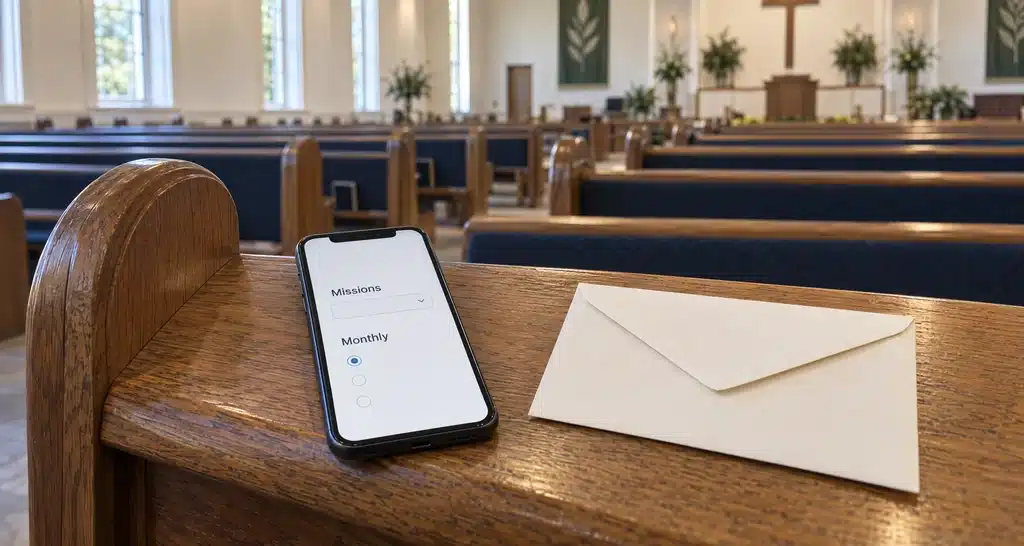
Digital giving is now the way many members prefer to support their church. The harder question is which channel to use. Some churches lean on Venmo, Zelle, or Cash App because members already have those apps on their phones. Others invest in dedicated church giving apps built for ministries. The choice affects far more than convenience. It shapes whether your donors can support their tax deductions, whether restricted gifts reach the right fund, and how much untangling your bookkeeper faces each January. This guide walks through what each option really means for your church, the tax rules that apply to every giving channel, and a practical way to decide what fits your congregation.
Why so many churches start with Venmo, Zelle, or Cash App
It is easy to see why peer-to-peer apps feel like the obvious answer. Most of your congregation already uses them to split dinner bills and repay friends. There is no monthly subscription, no contract, and no software to learn. A member can send a gift from the parking lot in less time than it takes to find a pew envelope.
For a small church without an online giving option, opening a Venmo or Cash App account looks like instant progress. Gifts arrive right away, younger members engage, and nobody has to carry cash on Sunday. That instinct to meet givers where they are is good stewardship thinking. The problem is not the instinct. The problem is what these apps were built for, and what they leave out.
The hidden problems with P2P apps for church giving
Mystery money: when you cannot tell who gave or why
Peer-to-peer apps were designed for personal transfers between people who know each other. A gift often arrives tagged with only a username and an optional memo. Your treasurer sees the deposit, but not reliably who gave it, which household it belongs to, or what it was for.
That creates what church finance reviewers call mystery money. If a member sends a gift intended for the mission’s trip and types nothing in the memo, the gift lands in the general fund. Honoring donor intent for designated gifts becomes guesswork, and guesswork is a poor foundation for restricted funds.
Fraud exposure and impersonation scams
Fraud is the second problem. Scammers have learned to create lookalike accounts that imitate a pastor or a church and then solicit gifts from trusting members. In 2025 the New York Attorney General sued the operator of Zelle over fraud connected to the platform. P2P transfers also move instantly and are difficult to reverse, which is exactly what a scammer wants.
A church is a high-trust environment, and that trust is the very thing impersonation schemes exploit. Members who would question a strange invoice will not question a giving request that appears to come from their pastor. Every informal channel you add widens that surface.
The burden on your bookkeeper at year end
The third problem shows up at year end. Each app is its own silo, so church bookkeeping now means logging into several platforms, exporting histories, and matching usernames to member records by hand before a single giving statement goes out.
Reconciliation suffers the same way. Your finance team must tie each app balance to the bank, month after month, across every platform in use. Many churches reach out for professional church accounting services at exactly this point, once informal channels have outgrown the volunteer who once kept up with them.
The tax side: deductions, receipts, and the 1099-K
Why gifts to a personal account put donor deductions at risk
The most serious risk with informal setups is where the account lives. When gifts flow to a staff member’s or volunteer’s personal account, the money looks to the payment platform, and potentially to the IRS, like a payment to that person. Under the IRS rules for churches, a charitable deduction depends on a gift actually reaching a qualified organization.
A gift routed to an individual may not qualify as a deductible contribution at all, much like gifts earmarked for a person rather than the ministry. The same logic appears in the rules on love offerings and gifts to individuals. The platform can even attribute the volume to that individual as income, which is a painful conversation nobody wants in February.
What the IRS requires to substantiate a gift
Deductibility also depends on paperwork the church must be able to produce. For a monetary gift of any amount, the donor needs a bank record or a written communication from the church to claim a deduction. For any single contribution of 250 dollars or more, IRC Section 170(f)(8) requires a contemporaneous written acknowledgment from the church stating the amount and whether goods or services were provided in return.
IRS Publication 1771 explains these substantiation rules in detail. Therefore the practical test for any giving channel is simple. If the church cannot reliably identify the donor behind a transaction, it cannot issue an accurate acknowledgment, and the donor’s deduction is at risk through no fault of their own.
What a 1099-K means for your church
Then there is Form 1099-K. Under current IRS guidance, payment platforms issue the form when goods-and-services transactions exceed 20,000 dollars and 200 transactions in a year. Congress has moved this threshold several times in recent years, so confirm the current rule before you rely on it.
A properly registered church account changes what that form means. A recognized 501(c)(3) receiving genuine donations into an account held in the church’s name, under the church’s EIN, should not owe income tax simply because a 1099-K arrives. Keep the form with your records, reconcile it against your giving data, and make sure the account registration actually points to the church.
If you keep a P2P option, set it up the right way
Some congregations will keep a P2P channel anyway, at least for a season, and there is a defensible way to do that. Start with the account itself. Register a charity or organization profile in the church’s legal name, not anyone’s personal profile. Venmo, for example, requires a documented charity profile connected to a business account for a nonprofit to receive donations properly.
Put the church’s EIN on the account, never a staff member’s Social Security number, and connect it to a church-controlled bank account with normal dual oversight. Assign one responsible administrator, with credentials stored where the board can retrieve them, so the channel does not walk out the door with a volunteer.
Then build habits around it. Ask members to include their name and any fund designation in the memo line. Record every app deposit in the accounting system promptly, in the same giving categories as checks and cash. Finally, have the board adopt a short written policy covering which channels are approved, who administers them, and how gifts are receipted. A channel your board has never discussed is a channel nobody is accountable for.
What dedicated giving apps do that P2P apps cannot
Dedicated giving platforms exist because churches kept hitting the limits described above. The difference starts with donor records. Every gift arrives attached to a known donor profile, so year-end statements generate automatically instead of consuming a volunteer’s weekend.
Recurring giving is the feature with the largest financial impact. Members set a weekly or monthly gift once, and giving stops depending on who happens to attend on a given Sunday. Fund designation is built in as well. A donor chooses missions, building, or benevolence at the moment of giving, which keeps restricted money traceable and supports clean fund accounting.
Platforms built for ministries also integrate with church management software, support text and app-based giving alongside cards and bank transfers, and provide reconciliation reports your treasurer can hand to an auditor. These tools carry subscription and processing costs, and no platform removes the need for good internal controls. What they do remove is the manual matching, the mystery money, and the receiving gaps that P2P channels create by design.
How to decide what fits your church
There is no single right answer for every congregation, but the decision usually comes down to a few questions. How much of your giving now arrives digitally? How many funds do you track? Who prepares your giving statements, and how long did they take last year? A church of forty with one fund has different needs than a church of four hundred running a building campaign.
For most churches, a dedicated platform as the primary channel is the sturdier long-term choice. It protects donor tax deductions, honors fund designations, and scales with growth. A properly registered P2P account can still serve as a secondary on-ramp for members who resist change, provided it follows the setup rules above and its activity lands in the books weekly.
Whichever direction you choose, decide it at the board level and write it down. Giving channels are part of your internal control environment, not a technology preference, and they deserve the same governance as any other financial policy.
When to bring in a specialist like ChurchShield
Moving giving channels touchesaccounting questions, donor acknowledgments, account registrations, and your chart of accounts all at once. A specialist who works only with churches can review how your current accounts are registered, whether your acknowledgments meet the substantiation rules, and how a platform migration should flow through your books. Consult the ChurchShield team through our church tax accounting and planning services before you make the switch, so your generosity infrastructure protects both your donors and your ministry’s exempt status.
Legal Disclaimer
This article is for educational purposes only and does not constitute legal, tax, or financial advice. Tax laws change and apply differently to each ministry’s facts and circumstances. Consult ChurchShield or your qualified tax advisor before acting on any information in this article.
Recent Comments